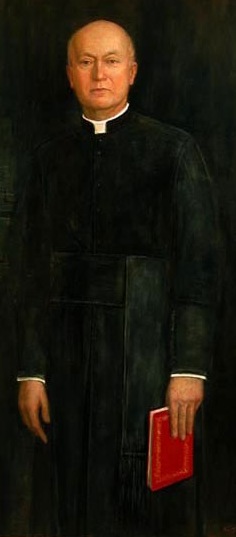
Showing posts with label Father George W. Rutler. Show all posts

Monday, December 15, 2008

Sanctity of the Family


FROM THE PASTOR
by Fr. George W. Rutler
October 26, 2008

Although city parishes are not commonly thought of as "family oriented" the way suburban parishes are, and while urban conditions make it costly and difficult to rear children, it is gratifying to welcome a steadily increasing number of families to our parish and to baptize the children of couples married here. Pope Leo XIII called the family "the cradle of civil society" and said that the destiny of states is largely fostered in the circle of family life.

As a reminder of the sanctity of the family as the "little church" or "ecclesiola," last Sunday the Church beatified the parents of St. Thérèse of Lisieux, who was canonized in 1925. Beatification is the last degree before canonization. The ceremony took place in the basilica of Lisieux, according to the preferred practice of Pope Benedict to have the beatification rite in the place where the blessed ones lived. Louis and Zélie Martin were not beatified because their daughter is a famous saint. Their own heroic virtue was attested by a miracle required in the beatification process: In this case, their intercession healed a man's malformed lung. Their earthly lives were outwardly ordinary, typical of a French bourgeois family in the nineteenth century. Louis was a prosperous watchmaker. He had wanted to be a monk, and needed the counsel of a priest to explain the sanctity of fatherhood. They were married in Alençon in 1858 and never ceased exchanging love letters. Five of their nine children joined religious orders. Their daughter, Saint Thérèse, wrote, "The good God gave me a father and a mother more worthy of heaven than of earth." After Zélie's death, Louis worked hard to care for his children with a contagious happiness.

There has been a widespread breakdown of family life in our society, due to many reasons including a loss of a sense of the holiness of marriage, worsened by government policies that threaten family stability. It is widely recognized that welfare programs begun in the 1960s backfired in their attempt to help children. Today this is worsened by civil attempts to redefine marriage against the natural law. Nonetheless, there is a desire on the part of many not to repeat the mistakes of the past. Many young couples have learned the importance of families the hard way, often through the failures of the last generation. In one recent five-year period for which there are statistics, couples with three or more children increased from 11.4% to 18.4%.

It may take a long time to repair to the damage done to society by misguided social engineers who scorned the traditional family, but the Church lives by the vision expressed by Pope Pius XI at a time when a fascist government tried to usurp the role of parents: "The family is more sacred than the state, and men are begotten not for the earth and for time, but for heaven and eternity."

Church Under Attack

FROM THE PASTOR
By Father George W. Rutler
October 12, 2008

The Holy Eucharist unites each congregation with our fellow believers throughout the world, along with the faithful departed in Purgatory and the saints in Heaven. Thus it is often said that the Catholic Church is too universal to be merely "international." The concerns of local churches in other lands should move us from preoccupation with local matters. The word "parochial" is a good one, referring to the parish as the local family of the Church, but "parochialism" can mean an isolated mentality.

The mainstream media has been poor in covering attacks on the Church. For instance, in Vietnam, where the government has been confiscating Church property and intimidating the faithful. The Archbishop of Hanoi, Joseph Ngo Quang Kiet, is under virtual house arrest, and Prime Minister Nguyen Tan Dung has threatened "extreme actions" against Catholic protesters.

The situation has been even more volatile in the last month in India where small but potent groups of Hindu extremists concentrated in Kandhamal have burned down about 4,500 Christian houses, 100 churches, and 20 other Church institutions, including convents and rectories. An estimated 50,000 Christians have fled into forests or live now in refugee camps or with relatives and friends in outlying areas. The situation is producing martyrs, such as Lalji Nayak in Orissa who refused to renounce the Faith at the point of a knife and died of his injuries a few days later. So far, about 50 have been killed, including a nun who was violated and a father and son who were hacked to death. Institutions founded by Mother Teresa and run by her Missionaries of Charity were set on fire and some of the lepers in their care were blinded by chemicals. The missionaries intend to return as soon as p ossible to care for patients with leprosy and tuberculosis.

Coincident with this, the first female saint of India will be canonized by Pope Benedict XVI this Sunday, October 12. Saint Alphonsa, daughter of Ouseph and Mariam Muttathupandathu, was born in Kottayam in Kerlala and died in 1946 at the age of 36 after many illnesses. India's first saint was Gonsalo Garcia, canonized in 1862. Garcia, who was from Vasai, was born of an Indian mother and Portuguese father in 1556 and was crucified in 1597 in Nagasaki. It is hoped that soon Blessed Teresa of Calcutta will also be raised to the altars. Mother Teresa walked through the streets of our parish more than once, and frequently remarked that the difficulties in her own land were not as bad as the materialism and indifference which afflicts so much of our own society. When we pray for our fellow Christians, we are doing a most concrete and practical thing. And when we contribute money we remember thankfully that part of it regularly goes to help others whose tragic conditions also occasion triumphs of holy religion.

Sunday, December 14, 2008

"Bodies—The Exhibition"


FROM THE PASTOR
By Fr. George W. Rutler
September 28, 2008

To bury the dead is one of the seven corporal works of mercy. The human body is to be treated with respect from conception through death. In the general resurrection of the dead, the body will be glorified in a mysterious way in union with the soul. The Church regulates the treatment of the dead (Catechism #2000). Burial of the body is normative, but cremation is permitted, provided that it does not signal disbelief in the resurrection of the body. In a large city, with cemeteries often far removed, it is still desirable that the body of the deceased be brought to the church for the funeral Mass before burial or cremation. Only by exception is a body to be cremated before the funeral and the ashes brought to the Mass. I am occasionally surprised when people are uninformed about these things and make funeral arrangements before c onsulting a priest.

A Manichean concept of the body virtually worships it as an idol in life and then treats it as irrelevant after it has lost its earthly usefulness. Contempt for God leads to contempt for the human body. At the South Street Seaport, there currently is a display of 22 whole bodies and more than 260 additional organs and partial body specimens. "Bodies—The Exhibition" is a version of "Body Worlds," which in recent years has exploited prurience in the name of scientific edification. The corpses are skinned, and the blood replaced with silicon polymers. These plasticized bodies are shown in various poses, sometimes whimsically. Dr. Thomas Hibbs, professor of ethics and culture at Baylor University, has called it pornographic.

The founder of "Body Worlds" is Gunther von Hagens, who invented the "Plastination" method at the University of Heidelberg. He is not culpable for his father having served in the Nazi SS in a perverse age when lampshades were made of human skin. That horrified people then. A generation later, more than 20 million people around the world have paid to view "plastinated corpses" for the thrill of it. Von Hagens moved to China in 1996 where bodies were more easily obtainable, some of them rumored to be the bodies of homeless or mentally ill people or executed prisoners. In 2004, bullet holes were found in two of the exhibited "sculptures." The anonymous bodies on display in Manhattan were taken from the Dalian Medical University in northern China. The New York State legislature this summer passed a bill requiring a declaration of the cause of death of the exhibited remains. Is it possible that if you visited this exhibition, you were looking at a Christian martyr

"Do you not know that your body is a temple of the Holy Spirit, who is in you, whom you have received from God? You are not your own; you were bought at a price. Therefore honor God with your body" (1 Cor. 6:19-20).

>

"What makes us smile should be a hint of heaven..."

FROM THE PASTOR
By Father George W. Rutler
September 21, 2008.

Catholicism has long distinguished itself from Puritanism in its joyful embrace of feasts and recreation. But while Puritanism disdained forms of entertainment basically because they were entertaining, the Church has been cautious of the tendency of entertainment to degrade instead of edify. For a long time, pipe organs which worked by water pressure were banned from the liturgy because they supplied background music for the martyrdoms of Christians in the Colosseum and Circus Maximus.

Politicians have long known how to exploit entertainment. The Lincoln-Douglas debates were highly amusing, with Douglas at five feet four inches matching himself against Lincoln at nearly six feet four inches. Whiskey flowed freely. Douglas orated in deep and sonorous voice in contrast to Lincoln's curiously high tenor. Both were honorable men and took each other and the crowd seriously. Douglas, whose wife and sons were Catholic, resisted the bigotry of the Know Nothing Party and willed his estate for the foundation of the University of Chicago. In their instance entertainment was to good effect.

The Roman satirist Juvenal (A.D. 55-127) knew the dangers of weak-willed people being manipulated by demagogues in exchange for spectacles and mindless celebrity. He marked the decay of republican Rome to the later imperial decadence when the Caesars bought support by offering panem et circenses, lamenting that "the people that once bestowed commands, consulships, legions, and all else, now meddle no more and longs eagerly for just two things—bread and circuses."

Ignoring the lesson that should have been learned from the Munich Olympics of 1936, staged to divert the world from the Nazi crimes, the media and business interests recently indulged the Beijing Olympics, expressing minor irritation at reminders that one and half million people had been dispossessed to build the Olympic center, and that political prisoners were suffering while the crowds watched a spectacle that outdid the choreography of Speer. On the closing day of the games, while the medalists were honored, the 73-year-old bishop of Zhengding, Julius Jia Zhiguo, was arrested for leading underground Catholics in celebrating the Feast of the Assumption. He will not be paid millions of dollars to endorse products on television.

Anyone who had not watched television for the last generation would find it hard to believe what passes for entertainment on the screen today: the coarse language and degrading acts and numbing banality. Classical philosophers connected legitimate pleasure with virtue: id quod visum placet, or "that which pleases," does not mean that any amusement is good. It means what pleases a person indicates that person's character. A beautiful soul is drawn to beautiful things, and what makes us smile should be a hint of heaven. Gratification only on the animal level is a glimpse of the opposite. George Bernard Shaw said that hell is a place where the only thing you have to do is amuse yourself.

Thursday, October 2, 2008

For the Record

FROM THE PASTOR
By
Father George W. Rutler
September 14, 2008

On the Feast of the Exaltation of the Holy Cross, the Church rejoices in the mercy of our Lord who suffered such a cruel death for our salvation. Mercy moved Christ to condemn most vigorously those who harm innocent life. Abortion is the defining moral issue of our age, as slavery was in the nineteenth century. In our country, the lives destroyed by abortion each day outnumber all combat deaths in war over the last ten years.

Although the bishops corrected the Speaker of the House of Representatives in her misrepresentation of the Church's teaching on life in the womb, she has persisted in her inaccuracies. On network television on September 7, one of the vice-presidential candidates repeated the same misinformation, even though he has been prevented by his bishop from speaking on church property because of his misstatements. For the record, the United States Conference of Catholic Bishops has published the facts:

1. From earliest times, Christians distanced themselves from pagan cultures by rejecting abortion and infanticide, as is evident in the New Testament, the "Didache" and "Epistle of Barnabas" and regional Church councils. The prophet Jeremiah (1:15) declared of God: "Before I formed you in the womb, I knew you." And the last and greatest of the prophets, John the Baptist, greeted our Lord while still in his mother's womb.

2. While the time of "ensoulment" in the womb was discussed by theologians such as Augustine, often referring to the writing of Aristotle and pre-Christian philosophers who had no knowledge of the existence of the human ovum, all of these theologians affirmed the Church's common conviction that life itself begins at conception and that abortion is gravely wrong at every stage.

3. Penalties for abortion often varied according to the stage of gestation, but abortion has always been seen as a grave moral evil from the moment of conception.

4. Modern genetics has demonstrated that the union of sperm and egg at conception produces a new living being that is distinct from both mother and father. From the mid-nineteenth century, all obsolete distinctions between the "ensouled" and "unensouled" fetus were permanently removed from canon law.

Politicians who relegate the facts of life to the category of religious views rather than natural law, ignore physical science; and they violate the traditional separation of church and state when they twist Christian moral teaching in the civic forum. The Church is patient with ignorance, but not with willful ignorance. Civil and religious leaders are equally accountable to the injunction of the prophet Ezekiel (33:8): "If I tell the wicked, 'O wicked one, you shall surely die,' and you do not speak out to dissuade the wicked from his way, the wicked shall die for his guilt, but I will hold you responsible for his death."

Wednesday, October 1, 2008

On "Ardent Catholics"...

FROM THE PASTOR
By Father George W. Rutler
September 7, 2008

The Roman consul Lucius Quinctius Cincinnatus (519-430 B.C.) was a model for our nation's Founding Fathers, who had no concept of a "career politician." Cincinnatus left his plough to serve his people and returned to his farm when his work was done. Today there are many politicians who have had no career except public office. This can tempt them to think that power trumps truth. Recently, Archbishop Chaput said: "Catholic public leaders inconvenienced by the abortion debate tend to take a hard line in talking about the 'separation of Church and state.' But their idea of separation often seems to work one way. In fact, some officials also seem comfortable in the role of theologian. And that warrants some interest, not as a 'political' issue, but as a matter of accuracy and justice."

Politicians who pick and choose the bits of Catholicism useful to their agenda are picturesquely called "Cafeteria Catholics." There are of course moral principles that permit prudential disagreement, as with economic policy, war strategies, and capital punishment. Abortion is different, because its evil is intrinsic. Like Typhoid Mary early in the 20th century, moral cafeterias can spread grave moral danger. It is safer to go with Blessed Mary than Typhoid Mary. But the latter, who infected 47 people, only three of whom died, acted unwittingly. There are public figures who willfully misrepresent Christ, and so they have His rebuke: "You are a hindrance to me; for you are not on the side of God, but of men" (Matt. 16:23). Ignorance is willful when it suppres ses information. At the recent convention of one of our political parties in Denver, Archbishop Chaput was not invited to give an invocation even though he is by far the most prominent religious leader in that area.

The Fourteenth Amendment remarks the difference between a citizen and a person in its refutation of the Dred Scott decision which, like Roe v. Wade, denied the human integrity of a person not vouchsafed the rights of a citizen. The former denied the right to liberty and the latter denied the right to life itself. The Lutheran theologian Dietrich Bonhoeffer, who was killed in the Flossenburg Concentration Camp, wrote: "Destruction of the embryo in the mother's womb is a violation of the right to live which God has bestowed on this nascent life. To raise the question whether we are here concerned already with a human being or not is mere ly to confuse the issue. The simple fact is that God certainly intended to create a human being and that this nascent human being has been deliberately deprived of his life. And that is nothing but murder."

If politicians want to campaign as "ardent Catholics" they should believe and act as ardent Catholics. As Archbishop Chaput has said from a pulpit better than any denied to him in the public forum: "If you're Catholic and you disagree with your Church, what do you do? You change your mind."

Monday, September 22, 2008

On George Edward Lynch

George Edward Lynch
1917-2003
by Rev. George W. Rutler
September 15, 2008

Satafi in Mauretania Caesariensi was a town in the western part of modern Algeria, and its chief claim to fame was that it was the birthplace of Marcus Opellius Macrinus who succeeded Caracalla as emperor, albeit for just 14 months. Because the Berbers there eventually were Islamicized, it was ripe as a defunct diocese to become the Titular See of George Edward Lynch (1917-2003) when he was ordained auxiliary bishop of Raleigh, North Carolina, in 1970. He retired 15 years later without having had a diocese of his own, save for that vague, arid African abstraction, but to thousands he was a most convincing specimen of apostolic succession as the vibrant DNA of the Faith.

Born in New York, he assumed that he would be a priest there, but soon enough he was recruited as a missionary in North Carolina, which to most New Yorkers in his time was as exotic as Satafi in Mauretania Caeasariensi. The Archdiocese of New York had an overplus of priests as the Diocese of Raleigh had an underplus, and soon after World War II George Lynch was inviting others to join him as priests where Catholics were rare and often unwelcome. Although he led opposition to racial segregation prudently and without strife, his work for civil rights did not make Catholicism blend into the cultural fabric. In 15 years as auxiliary bishop, he was able to see the fruits of his labor in the coalescence of a New South, and in retirement he was vigorous enough to take up a new cause when he returned to live with his sister in New York.

He latched on to the precedent of Thomas Lynch (no relation), one of the signers of the Declaration of Independence, as a model of the men who would "mutually pledge to each other our lives, our fortunes, and our sacred honor." I have a copy of his personal transcript of those words, in handwriting as neat and precise as he was in figure and regimen, tall and white-haired with a gentle manner and soft speech more Carolina than Bronx. Over the years of his work with Operation Rescue, he was arrested many times around the United States and abroad, including Russia. The circumstances of his confinement often were harsh, and yet he enjoyed the chance to evangelize men who were imprisoned for less altruistic acts. During a demonstration outside an abortion center in West Hartford, Connecticut, he was severely beaten by policemen who had removed their nameplates and badges.

Gradually all this took a toll on his health, and once during Mass at St. Agnes Church, where I was living, he fainted and returned after resting briefly on a vesting table in the sacristy. A happiness of his later years was celebrating Mass in the older Latin rite, and I do not think he ever excused himself from confirming thousands of young people, making the best use of his free years. From behind the scenes, John Cardinal O'Connor approved and encouraged his self-crafted apostolate in the pro-life movement, and when Bishop Lynch died in his 60th year of priesthood and 33rd as bishop, the cardinal privately remarked only half jokingly when the funeral was over that it might not be too soon to start work on his canonization.

It was during his sabbatical in Rome a few years before his retirement that I got to know him, he celebrating Mass and I preaching in the church of our patron San Giorgio in Velabro. At the time I was most conscious that it had been the titular church of Cardinal Newman, but now I also think of it for Bishop Lynch having offered the Holy Sacrifice there.

No one in that church of St. George had to persuade George Lynch that dragons are real. He dueled with them much of his life. In that letter of his that I have here on my desk, he says that "many who have been penalized by heavy fines, long prison terms, and in various other ways" for protesting against abortions could "say and mean" the pledge made by Thomas Lynch of South Carolina and his 55 fellow signers n 1776, "and I am willing, come what may, to be numbered among them."

Copyright © 2007, Morley Publishing Group Inc.

Wednesday, August 27, 2008

On Msgr Richard J. Schuler (1920-2007)

Richard J. Schuler

Rev. George W. Rutler
August 18, 2008

"In the earthly liturgy we take part in a foretaste of that heavenly liturgy which is celebrated in the holy city of Jerusalem toward which we journey as pilgrims. . . . We sing a hymn to the Lord's glory with all the warriors of the heavenly army." The Second Vatican Council's account of empyreal harmony clashes against the sad state of much church music today. Msgr. Richard J. Schuler (1920-2007) said at a liturgical conference in Paris that he was hopeful about music, since it was so bad it could not get any worse. The sounds of the holy city did seem to work its way down from the choir loft of St. Agnes Church, Schuler himself often conducting the orchestra. Whenever youths asked why they had been deprived of the Church's great repertoire, the pastor of that Austrian baroque church in the city of St. Paul indulged no reverie but rather let the music carry the day. Too Catholic to separate intellect and emotion, or to oppose tradition and transition, he presaged the "hermeneutic of continuity" preached by Pope Benedict XVI, whose election he watched liked an aged Simeon. He latterly said, "I have lived too long," but he was glad to have lived long enough to see a pope playing the piano.

Having stayed steady through the fads of one of the Church's most fickle generations, sometimes mocked by Philistines either nostalgic or anarchic, he gave sound to Augustine's "beauty ever ancient, ever new," and did it perhaps even livelier than the great bishop of Hippo who somewhat aridly described music as "the science of melodizing [modulandi] well." Two strains made his cultural harmony, as he was born the grandson of emigrants from Tirol and Baden-Baden and reared in an Irish section of Minneapolis. Otto, the father, had a fine shoe business and saw to it that his son, unlike the proverbial unshod child of a cobbler, should learn piano and flute and never think of music as peripheral to life. The Christian Brothers at De La Salle High School cultivated what Otto and his wife, Minnie, had sown, and he was an accomplished organist by the time he entered the College of St. Thomas in St. Paul. The formation in seminary, which he entered when just 20, was pedantic to his tastes, but he looked on it as a privilege as a world war roared around him. The new priest, ordained two weeks after the bombing of Hiroshima, taught music and history in the preparatory seminary while doing graduate studies at the Eastman School of Music. After studies in Rome on a Fulbright scholarship, he taught in the College of St. Thomas for 14 years and was made a doctor of music history at the University of Minnesota.

By founding the Twin Cities Catholic Chorale, he was able to put theory to practice, innovating the use of classical instruments with the new vernacularism while keeping Latin as the constant reference. As chairman of the Fifth International Church Music Congress in 1996, he began what seemed at the time a losing battle to promote the liturgical intentions of the Ecumenical Council. If the prima donnas of pastiche renewal claimed popular attention, he would make his parish a model of the Council's decrees, and for the rest of his life as pastor of St. Agnes Church he did just that: High Mass in the church, whose interior decor he refurbished and completed along with a bell named Richard added to the peal, was sung with Gregorian chant, and much of the Viennese school. Before preaching there one Sunday, the Mozart setting for the day was explained to me with unaffected eagerness by a small altar boy from the parish's school, whose catechism he preserved from external attempts to change.

Seminarians gathered in the rectory on Tuesdays for his counsel, as witty as it was "lux in umbris," and the aroma of a Sunday roast mingled with remnant incense to feed the young men who found their vocations there. Schuler's parish may have produced more priests than any in the country, and many of them are now serving in an archdiocese whose new life in recent years owes much to the man who was never disoriented in troubled years.

Dryden wrote:

From harmony, from heavenly harmony,
This universal frame began:
From harmony to harmony
Through all the compass of the notes it ran,
The diapason closing full in Man.

One such man had faced east at his altar day after day, warrior in earthly scenes -- and now, one may well think, not unprepared for the heavenly ranks.

Monday, March 10, 2008

From "Fishers of Men"

Father George Rutler
by
John Janaro

The Spirit of Truth works among all social classes, among men and women and powerful. Beyond their particular lifesituations there lies a deep unity among people, grounded in their common humanity and the call that each of them receives to share the life of God in Christ Jesus. It is not surprising, then, that men who share in the ministerial priesthood of Christ should come from all walks of life. Further united by their special conformity to the Person of Christ, priests nevertheless manifest the richness of Christ and His redemptive action within the context of their own background and personal development, which brings to the ministry of each a particular character and relevance.

For Father George William Rutler this character is well defined, and the fruit of a unique collection of experiences. Fr. Rutler is an Ivy League graduate, a musician and painter, an art historian with an extensive collection, a sportsman and long distance runner, and a writer and lecturer with a considerable breadth of education and a wealth of erudition. His priesthood, however, is central to his life, and his range of interests and activities serves to mold him into an apostle who is capable of preaching the Gospel in a wide variety of situations and with a deep and penetrating knowledge of people.

Furthermore his priesthood is something that he particularly cherishes because his vocation was intimately connected to a journey of faith—ajourney that brought him to full communion with the Church of Christ and to the mission of deepening and strengthening that Church.

"His love is strong, his faithfulness eternal" (Ps. 117:2). This path of the Spirit began for George Rutler in a pious Episcopalian home with devoted parents. Adolphe Rutler saw duty in the second World War as a Merchant Marine officer on convoys to Russia in the years prior to George's birth on March 23, 1945. George's childhood was filled with the familiar scenes of Anglican life; like many Episcopalian boys he sang in the church choir, and he would be in church every Sunday, sitting attentively in his choirboy's starched collar and listening to the rector preach. Perhaps someday he would preach in the same way, he often thought to himself.

When George entered school in New Jersey he had already begun to demonstrate that he had unusual intelligence. At the age of five he memorized the Gettysburg Address so that he could present it to his kindergarten teacher. As he approached high school he developed a love for the Classics, and his abilities had enabled him to skip several grades. Thus at the tender age of 12, George entered the advanced program of the public high school.

He also became more familiar with the world around him. This world included Catholics who engaged in a variety of practices that were more or less unfamiliar to George. He remembers once entering a Catholic church as a small boy, seeing the multitude of candles, and thinking that the church was on fire!

George mainly remembers associating Catholics with certain ethnic and cultural groups. The thought that an Anglo-Saxon like himself could ever be a Catholic never entered his mind. It just wasn't something that was done. Beyond these impressions George knew very little about Catholicism; he was aware that there was "a very important and good Christian gentleman" in Rome who called himself "Pius XII." He also knew that the Catholic Church was vast, and at the time seemed to him rather "unfriendly."

Therefore when George graduated high school at the age of 16, the Catholic Church — large but foreign, and apparently irrelevant to his situation — occupied no important place in his life. His long term goal was to become an Episcopalian clergyman, a task that seemed worthy of his intelligence and his genuine zeal for God's word. In 1961 he began four years at Dartmouth, and the Ivy league atmosphere — permeated with a sophisticated skepticism — moved the young college student to react by reflecting more deeply on his religion. Modern atheistic philosophies, masking themselves as "intellectual," obviously did not provide the answers. George's French teacher was an existentialist who, after having his students read Sartre and Camus extensively, one day committed suicide. It did not seen as though truth could be found in such futility. "The believer shall not stumble" (Is 28:16).

Historical study, however, revealed the development of the Christian faith, and the origins of the "Anglican Communion" to which the Episcopal Church in the United States belonged. George saw that the Church of England had split from the Church of Rome in the 16th century, and he wanted to be sure that his own faith was rooted in the teaching and mission of the apostles and not the product of some confusing set of historical circumstances. This desire moved him toward a particular perspective of high Anglicanism known as "Anglo-Catholicism," that emphasized doctrine, ritual, and apostolic sense. The connection between the Church and Jesus Christ, he concluded, was of the utmost importance;"since we have a great priest over the house of God, let us draw near with a true heart . . ." (Heb. 10:21-22).

Meanwhile, the "Roman" Church had convoked an Ecumenical Council, an event that made no impression on George while he was in college. "High Church" Episcopalianism seemed vital in 1963, and took most of his attention. He became aware of the Oxford Movement, a trend within Anglicanism that had flourished in the 19th century. The Oxford movement had sought to restore authentic apostolic Christianity to the Church of England, and George immersed himself in the thinking of the great 19th century Anglican doctors, Keble and Pusey. One other leader of the Oxford Movement, however, seemed a bit untrustworthy. John Henry Newman was a rather disturbing fellow and George thought it best to avoid him, viewing him as "a man of nervous temperament who couldn't weather the storm and just went off and became a Roman Catholic." It seemed to George that the man whom Catholics call "Cardinal" Newman had "lost his faith."

In 1965, at the age of 20, George received his BA (cum laude) from Dartmouth. With a grant from the Ford Foundation he pursued graduate studies at the Johns Hopkins University, receiving an M.A.T. in 1966. Only now was he old enough to enter the General Theological Seminary in Manhattan. Covering an entire block of New York City, the GTS was like an English cloister complete with tutors from Oxford and Cambridge. At this time the GTS seemed relatively untouched by the turmoil raging in the seminaries of the Roman Church, and George received a thorough formation in an Episcopalianism styled very much after the Oxford Movement.

During his years in the seminary he spent summers in England, at Oxford University and assisting in the poor parishes of London's East End. He excelled in his studies and graduated first in his class in 1969, after which he was ordained to the Episcopalian priesthood and assigned to Rosemont, a church outside of Philadelphia.

Rosemont was an exemplar of high church Anglicanism; its 14th century Gothic style structure served a parish comprised of intellectuals andmembers of "Old Philadelphia" society While a curate (a position that resembles that of associate pastor) Rev. Mr. Rutler received a doctoral fellowship to Oxford and, after a year and a half serving the parish, he had determined to go to England and finish his studies. In fact, he had already begun his dissertation on Newman, who had proven simply too troublesome to ignore.

Events, however, brought about a significant change in his plans. The rector of Rosemont left for a parish in New York, and the "Wardens and Vestrymen" of the Rosemont Parish elected George Rutler as the new rector. Believing that he was called to shepherd a flock, and upon the advice of his bishop, he gave up his doctoral fellowship and devoted himself to parish work.

Thus at the age of 26, the youngest Episcopalian rector in the found himself torn by a variety of ambitions, desires, and the mysterious stirrings of his heart. He enjoyed tending the needs of his suburban parish, riding a bicycle to his house calls and hospital visits. He also served as chaplain at Bryn Mawr College. The stimulating life of an Episcopalian rector seemed quite attractive, and George gave quite abit of thought to the idea of settling down and raising a family. Marriage is an option for the Episcopal clergy, and the young clergyman was considered an eligible bachelor in Philadelphia society. He attended parties, gave lectures, and lived a pleasant life in a spacious and comfortable rectory.

By all secular standards George Rutler should have been quite satisfied. He was convinced, however, that something was missing; the fullness of the demands of the Gospel had to be met. He began to realize that much of Anglicanism took its outlook from the prevailing cultural establishment. It had remained stable for many years because of the relative stability of the society. Now, however, social and moral attitudes were changing all around, and the whole Episcopalian structure seemed to be following a path of accommodating itself to the new social perspective.

"Can a man make for himself gods? Such are no gods!" (Jer. 16:20). George Rutler was troubled in spirit. Was there so little substance behind the Anglican commitment to the Gospel? Commitment to the Gospel requires conformity to Christ as He is present and active on earth. Where could he find this presence of Christ?

The young rector found himself reading the (Apologia Pro Vita Sua) of John Henry Newman. Newman's reasons for becoming Catholic struck him and filled him with a certain uneasiness, but also a profound interest. He sought out an old seminary teacher, soon to become bishop, who advised him to stay away from that "dangerous book." But he did not take the advice; instead he read it again. "When I read Newman's Apologia it seemed to me that just change the names and places, and it was rather what I was seeing around me."

"God is light; there is no darkness in him at all" (IJn. 1:5). The Holy Spirit was moving George Rutler to seek a full and firm foundation for his service to Christ. As this inspiration increased, his desire for a successful and amiable life in the rectory decreased. He saw himself more and more as someone called to preach the Gospel, and to embody that Gospel in his own life. He gave up the idea of marriage and joined the Oratory of the Good Shepherd, an international union of Anglican clergy who have a common rule of prayer and meet annually for a retreat in an English university or monastery. He was now prepared to dedicate himself totally to seeking God's will, and leading others to Him.

Nevertheless, he was surrounded by a spirit of capitulation. In 1976 the Anglican Communion voted to permit the ordination of women. He found himself confronted with a harsh reality: "Via Media", or "Middle Road" of Anglicanism was dying. As he watched the sand being washed away from under the edifice of the Episcopal Church, his eyes turned toward the Church of Rome, and the Rock upon which it is built. "Simon, son of John, do you love me" (Jn. 21:17)? On a pilgrimage to the Holy Land, he spent a night by the Sea of Galilee thinking of those words. Objections to the primacy of the See of Peter seemed to fade in the light of the glowing witness that Peter had given, and was still giving to the integrity of the Gospel, an integrity his own Church had abandoned. "If it were wrong to have a Pope," he thought to himself, "it had to be very wrong that he should be so right."

"Still he remained with his parish, convinced at the time that he could not abandon the flock entrusted to his care. After nine years, he had baptized and buried many, and there were countless friends. Soon, however, it became apparent to him that even his parish was slipping away. The Episcopal bishop had set up a collection to raise funds for a "counseling center" that was involved in promoting abortion. The young rector could not in conscience participate; it was obvious to him that abortion is the killing of innocent human life. The parish vestry, however, was willing to permit the collection to be taken; to take a stand against it would have been to violate the status quo, and that would have been most unpleasant indeed.

Meanwhile the remnants of the Oxford Movement had a voice in its century-old organization called the American Church Union. The ACU served as a national "umbrella" group for high church loyalists as well as for congregations that were splitting away from the Episcopalian structure. One important component of their efforts was the establishment of a journal called the (New Oxford Review). Rutler became increasingly involved in the ACU and began to write for the journal, which adopted a new name at a conference held in Rosemont.

Thus in 1978, after having been elected national president of the American Church Union, he was able to resign the Rectorship at Rosemont. (Affectionate ties with Rosemont still remain, and a marker in the church commemorates the years that Fr. Rutler served there.) He was "be ambitious for the higher gifts" (ICor. 12:31). The vision of the Gospel — the generosity and universality of the redemption of Christ — is much deeper, much more relevant, much more permanent than any superficial conformity to the standards of the day. Jesus is more radical than that; more daring and less subject to passing whim or established etiquette. "I stopped looking for what is correct," he reflects, "and began seeking what is holy.

"The new president of the ACU, was convinced that the organization should consolidate all disaffected Episcopalian groups and make a collective submission to the See of Peter. The ACU, however, composed of many bishops and thousands of clergy and laity, was in disagreement about the direction of its future, and its president realized that God was calling him to make his submission alone.

It was not any easy decision to make; Rutler felt a deep sense of loyalty to the people who looked to him for leadership within the ACU He also knew, however, that the truth had called him - that "any future determination of my life's work should be measured by nothing other than its harmony with the will of the Holy Spirit."

"That Spirit was now speaking in bright terms to anyone willing to listen, revealing the power and reliability of the Holy See, the guarantee of the voice of the Spirit and of the unity He ensures. A new Pope had been chosen in the fall of 1978; a man who had endured all the evils of the 20th century — atheism, fascism, communism — and who had proclaimed the Gospel in the midst of them with humility and genius. Karol Wojtyla was an inspiring choice, uniquely prepared to preach the word of God to this age with the authority of Christ. "It was quite clear that the Holy Spirit was doing something miraculous," George William Rutler recalls, "and I wanted to be a little part of it."

"In the one Spirit we were all baptized" (ICor. 12:13). In September of 1979 he approached Terence Cardinal Cooke, Archbishop of New York, and requested to be received in the Roman Catholic Church. Rev. Rutler did not know what would constitute his service within the Catholic Church, or if he could even be a priest, but he knew that he wanted to be a shepherd. It had become almost an instinct for him to lead, and that instinct now manifested itself as a call to share in the priesthood of Christ, to possess a priesthood that had direct contact with the Body of Christ, immersed in and offering His sacrificial love.

On September 28, 1979, George Rutler embraced the fullness of the Christian life in union with the Body of Christ, formally entering the Catholic Church in a private ceremony at St. Patrick's Cathedral. As he awaited his first communion in the Mass that evening, he reflected upon the reading from the Old Testament appointed for that day. The prophet Haggai proclaims: "The silver is mine, and the gold is mine, says the Lord of Hosts. The latter splendour of this house shall be greater than the former, says the Lord of Hosts; and in this place I will give prosperity, says the Lord of Hosts" (Haggai 2:8-9).

This indeed was a familiar passage; it was the text of the first sermon hehad preached at his installation as Rector in Rosemont. The call of the Holy Spirit was consistent, and assured him that all the gifts God had given him as an Anglican had not been lost; rather they had been fulfilled at last. The Church that had at once seemed so foreign was now seen as home, and he knew that nothing he had left was greater than the mystery that lay ahead of him. With this in mind, George Rutler rose from the pew and approached his Eucharistic Lord.

Cardinal Cooke was determined that his new convert should pursue the Catholic priesthood. Sent to Rome to fulfill any requirement that might stand between him and ordination, "Mr" Rutler found himself in a curious position. Living in the North American priests' residence, he watched the others say Mass and hoped for the day he could join them. Formerly he had had a staff and a large residence on Fifth Avenue; by contrast his new room in Rome had a bare lightbulb and a broken window with an obscured view. Yet this was a glimpse of the joyful detachment that brings a man close to Christ, the poverty that makes saints. "The Son of Man has nowhere to lay his head" (Mt. 8:20).

For two years George Rutler studied theology in Rome during which time hewas ordained a deacon. Then he returned to New York to answer the call of Cardinal Cooke. This bishop, who possessed the full and authentic commission given by Christ to his apostles, stretched forth his hands and communicated that commission to Fr. Rutler. An eternal priesthood — instituted not by mere men but by God Himself — took hold in his soul. Back in Rome, he completed his doctoral studies, finishing the thesis on Newman that he had begun at Oxford. The holy Cardinal who had captured his attention, pricked his conscience, and enlightened his mind was present once again as his journey reached its summit.

Fr. Rutler returned to the United States and began his service in the Archdiocese of New York. The whole of his life experience had taught him a great deal about the challenge of Christian life and the manner in which that challenge should be presented to all kinds of people. And now he had the power of the sacramental and preaching ministry; he was the hands of Christ, reaching forth to bind the wounds of His sheep. "l will feed them with good pasture . . ." (Ez. 34:14).

As associate pastor in Bronxville, New York he found himself very happily in a teaching position... with the kindergarten class of the parish school. A year later, he was assigned to Our Lady of the Victory Church near Wall Street, a church that provides the Eucharist and many hours of confessions daily for the businessmen, stockbrokers, and bankers who makeup the financial district. Here Fr. Rutler, whose preaching ability began to be widely recognized, had an opportunity each day to proclaim the Good News of Salvation to some of the most influential people in the world.

Furthermore he was able to make that salvation available — to communicate its power — through the Sacrament of Reconciliation. Fr. Rutler is convinced of the central importance of this healing ministry in the life of a priest: "a priest should never spend more time eating in any given day than he does hearing confessions." Spiritual food for others, he reasons, is more important than ordinary food for oneself.

In order to draw men to repentance — to the conversion of heart that begins and sustains one's life in Christ — they must be moved to seek the life of God. Fr. Rutler observes that many of the younger generation - who are now assuming places of importance in business and professional fields - have grown up selfish and indulged, without a sense of sacrifice and without adequate instruction in the Faith. Thus, when Fr. Rutler approaches the church pulpit he aims to break people out of the "secularism" that they have ingested during the course of their daily lives without even realizing it. When this contact has been made, he can begin to instruct, and to challenge people with the demands — and the splendor — of sanctity.

He observes that "when the new generation comes into contact with the authentic teaching and the interior life of the Church, it is a revolutionary discovery, even if they consider themselves to have been Catholic all along." This sense of discovery, which has guided and shaped his own life, also forms and directs his preaching mission.

"And men from the east and west, from north and south, will come to take their places at the feast in the Kingdom of God" (Lk. 13:29). This mission above all centers on the universal vocation to holiness. Fr. Rutler sees the call to live God's life in fullness and fervor as one of the key themes of the Second Vatican Council, and the foundation of the whole renewal of the Church. The lay people must be respected as full members of the Church, truly the People of God who are called completely and without compromise to a share in the Promised Land of God's Kingdom. "Too many priests, because we are sinners, are embarrassed at telling people they have to be saints," Fr. Rutler notes. Yet the call to sanctity is the cornerstone of the dignity of the lay person. A priest who fails to preach this message inevitably takes a patronizing attitude towards the laity.

Fr. Rutler sees this kind of attitude behind a false type of "clericalism" that infects the way many people view roles within the Church. Too often the priesthood is perceived solely in terms of a bureaucratic professionalism rather than as the task of making present the salvific ministry of Jesus. Fr. Rutler notes that when priests are considered the "professionals" of the Church, it appears as though the only worthwhile task in the service of the Gospel is priestly work. Thus in previous times lay people were not sufficiently encouraged to seize hold of their own role in the life of the Church, while in the contemporary situation some priests think that in order to involve the people in the Church they have to put them at the altar doing specifically priestly functions. Both attitudes, Fr. Rutler insists, deny the value of the unique task of the laity to evangelize the world from within.

"... by one man's obedience many will be made righteous" (Rom. 5:19). Fr. Rutler is determined to inform all of his priestly activities with that sense of the universal call to holiness, linked as it is to the universal mission of the Church of Jesus Christ. He has recently begun auniversity chaplaincy and now lives at St. Agnes Church on 43rd Street in Manhattan. Here he encounters a wide variety of business people as well as the whole range of society that passes through the busy life of mid-town Manhattan on any given day. The variety and richness of experience in his own life enables him to reach out to a diverse community, and his own spiritual journey has invested him with a keen insight into the mystery of the Church and its significance in the lives of everyone. "It is hardly enough to say 'I obey the Pope.' We have to be taught to love the Pope, to love the Church," he says.

This love for the Church, springing forth from a profound love for Jesus Christ, is the fruit of Fr. Rutler's search and the center of his experiences, his apostolate, his witness. From the Ivy league and Episcopalianism to Rome and the Rock of Peter to a world that longs for the message of salvation, Fr. Rutler has followed and continues to follow the spirit of Christ; he has been summoned to embrace the unity of the Church, to foster that unity, and to deepen that unity. The holiness that Fr. Rutler seeks for himself and for the people in his care finds its source in the unity which is Christ, whose presence is the strength and the guarantee of the life of God's people.

Chapter 7 of "Fishers of Men" published by Trinity Communications in 1985
Copyright © Trinity Communications 1994

Sunday, February 17, 2008

Father Georges William Rutler

Father George William Rutler

Father George William Rutler, a priest of the Archdiocese of New York, is a graduate of Dartmouth and Johns Hopkins and holds advanced theology degrees from Oxford and the Angelicum in Rome (S.T.D.). He is by far the best-known priest at St. Agnes parish in New York City (and probably one of the most famous in the United States). He is a prolific author of books (published by Ignatius Press) and articles. He has made several television series on Mother Angelica's Eternal Word Television Network (EWTN). Tapes of his lectures sell as well as those of any figure in the Catholic world. He is also the chaplain of Legatus, an organization of Catholic CEOs founded by Domino's Pizza Chairman Tom Monahan.

Father Rutler looks like a nineteenth-century English saint--and sounds like one, too, as unlikely as it seems that a boy raised in Patterson, New Jersey would have an Oxbridge accent; it's a consequence of many years of study abroad. Father Rutler used to be an Anglican priest; a distinguished career lay ahead of him in the Episcopal Church. But the Anglican's growing resemblance to the Democratic Party, in addition to theological and spiritual reasons, sent him to Rome in 1980.

Father Rutler is known for many things. He is known for a wicked sense of humor; at an elegant Manhattan fundraising dinner that he emcees every year, he once referred to Msgr. Eugene Clark as "the Mother Teresa to the rich." He is a fine prose stylist; his column appears monthly in Crisis magazine, and his wit has often been compared to G.K. Chesterton's. He is an especially gifted homilist; many people track down his wildly fluctuating Mass schedule in order to be present at one of his three-minute sermons. His programs on EWTN are among its most popular. He is even an accomplished landscape artist.

What Father Rutler is best known for around St. Agnes and New York are his Good Friday sermons. He has inherited the mantle of orator of St. Agnes from Fulton Sheen, who presided over four Good Friday services. Father Rutler has done twelve. Before the church burned, people used to arrive at St. Agnes early in the morning to make sure they got a seat. After the fire, the service was moved to the Grand Ballroom of the Waldorf Astoria Hotel, which has been a godsend. It holds over 1,200 people, and it is standing room only. Starting at 12:00 and ending at 3:00, Fr. Rutler takes the parishioners through the death of Christ on the Cross in his own particular way. One year it was "The Seven Last Words of Christ and the Seven Wonders of the Ancient World." Another compared the seven last words with the seven deadly sins. He delivers seven sermons in those three hours without a note; and then they are published almost verbatim in book form. Hugh Carey, former governor of New York State, recalls: "I was there one year, and it was such a wonderful experience that I ran outside to a pay phone and called all my sons and told them to meet me immediately. They all came. Father Rutler is an amazing priest."

Father Rutler says St. Agnes is important for the atmosphere it creates. "When people enter St. Agnes they know immediately they are entering a sacred space," he says. "But it isn't a stuffy or exclusive place. It is like the Catholic Church as a whole. The Catholic Church leaves room for casual and anonymous curiosity. You can come in, stand around, and get comfortable with it. I am reminded of a sign that Ronald Knox spotted in a Catholic Church: 'Mind Your Umbrella.'" Father Rutler explains that Catholicism is so open that anyone can come in, but that that freedom also includes the thief, or a street person. "A bag lady came up to me one day and quoted something I'd said in a Good Friday service." That's St. Agnes, and Catholicism.